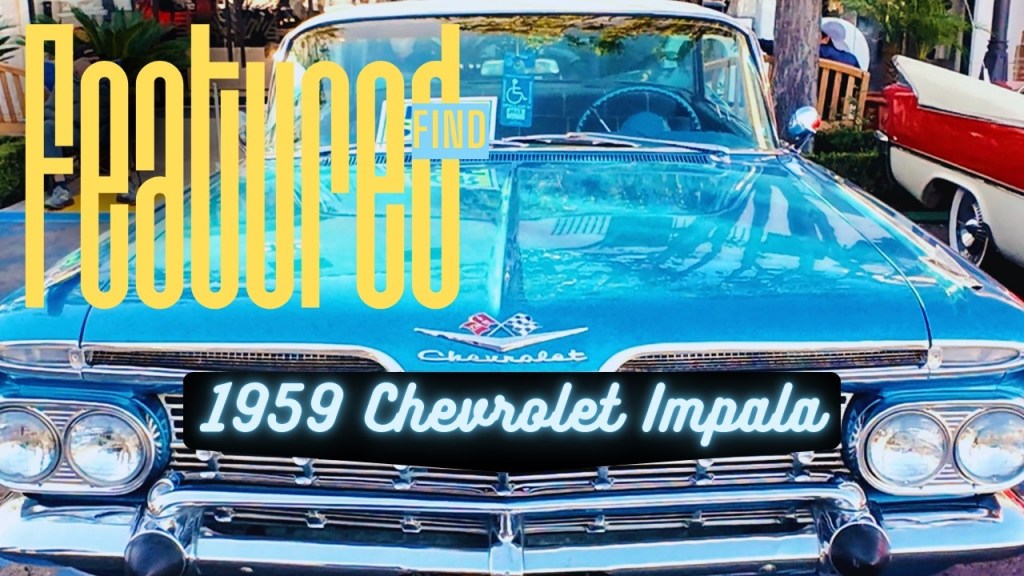
Today’s featured find is a 1959 Chevrolet Impala, one of the pivotal cars to come out of Detroit’s postwar design wars.
GM’s 1957 Wake-Up Call
1959 was a seminal year at General Motors. Leadership was in transition, with Harley Earl handing the reins of GM design over to Bill Mitchell, and the timing couldn’t have been more consequential. GM’s designers and engineers had gotten an early look at Chrysler’s 1957 lineup, marketed as the “Forward Look” for being lower, sleeker, wider, and altogether less heavy-handed than anything else on American roads at the time. GM realized almost immediately that its own 1959 plans needed a total revamp, and fast. The pressure to move quickly and cut costs led to a solution that shaped GM’s entire full-size lineup for the year: one shared platform underneath every division’s full-size car.
One Platform, Four Divisions
Look past the badge and the shared bones become obvious: the sweeping wraparound rear window, the wraparound windshield, and even the front and rear doors were common across Chevrolet, Pontiac, Oldsmobile, and Buick’s full-size cars for 1959. The trick was that each division kept its own styling details and powertrains, so customers never clocked how much was shared underneath. Whatever GM’s engineers pulled off with the platform, it clearly worked — these cars sold extremely well, and the design still holds up today.
Design Details Worth a Second Look
This particular Impala wears an eye-catching blue vinyl-and-cloth interior, and outside, a band of contrasting white paint and stainless trim runs the full length of the car. From the back, the sweeping rear fins, nicknamed “bat wings,” cascade down over teardrop-shaped, cat-eye taillights. The California black-and-yellow plates are period correct, and the knockoff-style wheel covers finish the look.
Up front, quad headlights flank a functional arrow-shaped grille detail. It’s easy to forget now, but quad headlights weren’t legal across all 50 states until 1958, which made them a genuinely new look at the time. Sweeping around the front fender, there’s a striking space-age “jet” motif that seems to glide across the sheet metal — a clever nod to the Space Race that was just getting underway.
The wraparound glass shows up again at the windshield, and the pillarless side windows are unique to what Chevrolet marketed as the Sport Sedan, known internally at GM as the “flying wing,” though most enthusiasts just call these cars flat tops. Above the rear window sits a hooded vent that looks functional but isn’t: it was originally designed for flow-through ventilation, but it ended up pulling exhaust into the cabin instead, so GM scrapped the function and kept the look, because they liked it too much to let it go.
Around back, the long rear fins are a genuinely complicated steel stamping — the kind of labor- and tooling-intensive work that’s essentially disappeared from the modern car industry. Where the fins meet the fenders, there’s a hand-finished seam filler, blended smooth by hand but only up to eye level. It’s a crude solution in principle, and a remarkably effective one in practice, on a wildly complicated design.
By the Numbers
The Impala nameplate itself was brand new in 1958, launched as a one-year-only top trim of the Bel Air. For 1959 it broke out into its own model, and it did not waste any time making a name for itself: this generation became the bestselling car in America for 1959, moving roughly 473,000 units.
Watch the Full Walkaround
Want the full walkaround, straight from the driveway? Watch the complete video here: 1959 Chevrolet Impala – MOPAR vs. GM: How the “Forward Look” Forced a Radical Shift in Design 🎥

Leave a Reply